

Introduction
Running a moving company in today’s environment is about more than household or office relocations. Customers want faster service, new revenue models are required to stay competitive, and trucks sitting idle during off-peak seasons represent lost opportunity. For many owners, the question is simple: what else can I do with my resources to drive more revenue?
That’s where delivery services step in.
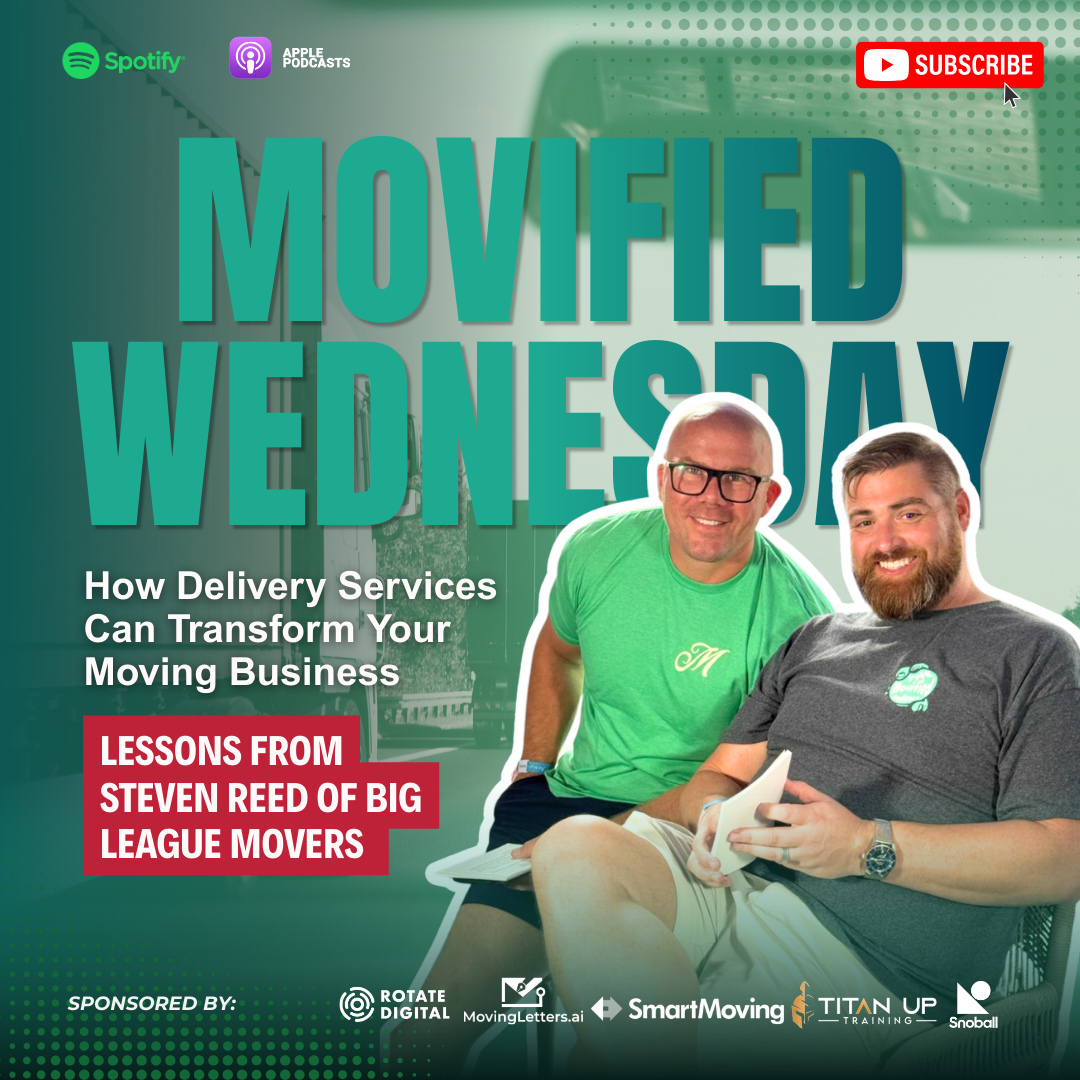
In this special Movified podcast episode, Mark Hirschi, owner of Salmon’s Moving & Storage and host of Movified Wednesdays, sits down with Steven Reed, founder of ReadyRoles.com and Big League Movers in Memphis, Tennessee. Steven shares how he transformed his moving business by launching a dedicated delivery arm. From day rates for drivers to mastering billing systems, he reveals both the mistakes and the lessons that helped him succeed.
This guide turns that conversation into a blueprint for moving company owners, franchisees, and industry professionals who want to explore delivery services as a profitable diversification strategy.
Key Takeaways
What You’ll Learn:
- Delivery services require a completely different workflow than moving.
- Routing and billing software are critical to avoid profit leaks.
- A truck must generate at least $800/day to make logistics viable.
- Strong contracts, administrative systems, and team leadership determine long-term success.
- Off-dock partnerships with retailers are a smart entry point before leasing warehouses.
Table of Contents
- Why Moving Companies Should Consider Delivery Services
- How Delivery Differs from Traditional Moving
- Software, Pricing, and Daily Revenue Targets
- Lessons Learned: Steven Reed’s Journey
- Building Teams, Contracts, and Pay Structures
- Warehousing, Dock Work, and Partnering with Retailers
- Common Pitfalls Movers Face in Delivery
- Why Choose Movified
- Conclusion
Why Moving Companies Should Consider Delivery Services
Adding delivery services allows moving companies to tap into year-round demand. Unlike moving, which peaks during summer and slows in winter, delivery demand remains steady—especially with e-commerce and furniture retailers relying on outsourced logistics.
For a moving company, this means:
- Maximizing truck utilization. Instead of sitting idle, trucks can generate income every month.
- Retaining staff. Steady work helps reduce turnover by keeping crews employed.
- Diversifying revenue streams. Reducing dependence on seasonal moves creates financial stability.
Steven Reed explains it clearly: when he shifted into deliveries, he realized it was “an entirely different business”. But once he built the right structure, it became a reliable profit driver.
Image suggestion: A delivery truck loading at a dock — ALT text: “delivery services for moving companies generating revenue year-round”
How Delivery Differs from Traditional Moving
At first glance, deliveries may seem similar to moves: trucks, crews, and furniture are all involved. Yet the back-end operations could not be more different.
In moving, customers typically pay on the same day, often with credit card or cash. In delivery, accounts are billed later, sometimes with 30–60 day payment cycles. That alone requires a completely different cash flow system.
Other differences include:
- Workflows: Delivery jobs are shorter and more numerous, requiring strong route optimization.
- Billing: Accessorial charges—stairs, assembly, waiting—become essential for margins.
- Customer expectations: Clients may include retail chains or third-party logistics (3PL) companies with strict performance metrics.
Steven warns that many movers fail at delivery because they underestimate these differences. “Most of our work in moving is simple cash flow. In final mile, you need to be a billing machine.”
Software, Pricing, and Daily Revenue Targets
One of Steven’s strongest recommendations is investing in DispatchTrack, a software platform built for routing and delivery. For around $70 per truck per month, DispatchTrack provides:
- Route optimization to cluster stops
- Automatic text notifications to customers
- Real-time delivery receipts with photos
- QuickBooks integration for billing
Without a system like this, delivery quickly becomes chaotic.
Setting the Right Price Point
Steven also stresses a hard rule: never run a truck for less than $800 per day.
That figure covers:
- Labor (driver + helper)
- Fuel and maintenance
- Insurance and overhead
- Profit margin
Anything less, and the truck is losing money. In negotiations, logistics buyers already know these margins. The mover’s job is to demonstrate consistent performance to win better rates over time.
Lessons Learned: Steven Reed’s Journey
Steven’s first attempt at delivery in Atlanta was bold but costly. He launched seven trucks handling nearly 900,000 annual cabinet deliveries. Traffic delays, administrative overload, and steep learning curves resulted in major financial losses.
Selling that branch gave him the chance to rebuild in Memphis. This time, he created On Deck Deliveries as a separate entity from his moving company. He scaled slowly, focused on administrative strength, and only expanded when systems were ready.
That patience paid off. Today, On Deck Deliveries runs eight trucks daily, supported by ReadyRoles.com for streamlined management.
Steven’s takeaway: “Don’t jump all in without systems. Build slow, build right, and then scale.”
Building Teams, Contracts, and Pay Structures
Logistics success depends on people as much as software. Steven highlights Jason, a team member who grew from driver to warehouse leader. His steady leadership allowed Steven to expand without losing control.
Day Rates and Bonuses
Instead of hourly pay, Steven uses day rates. Drivers and helpers earn a flat rate, with bonuses for reporting accessorials like stairs. This model creates predictability and motivates crews to capture revenue opportunities.
Contracts
On the legal side, Steven worked with Patrick Maybach, “the moving attorney”, to draft strong contracts with drivers and contractors. For logistics accounts, terms are often dictated by the customer, but excellent service opens the door for renegotiation.
Warehousing, Dock Work, and Partnering with Retailers
A major barrier for movers entering delivery is warehousing. Leasing space is costly, and not every company can handle inbound shipments. Steven’s advice: start off-dock.
By partnering with large retailers like Williams Sonoma or Ashley, movers can:
- Use the retailer’s dock and systems
- Gain hands-on experience with deliveries
- Avoid warehouse overhead while learning
Steven himself got started by running routes for Pottery Barn, learning processes directly at their distribution centers.
Common Pitfalls Movers Face in Delivery
Many movers underestimate the challenges of delivery. Some of the most common pitfalls include:
- Underpricing contracts. Without the $800/day rule, margins vanish.
- Weak admin systems. Poor billing or missed accessorials quickly erode profits.
- Driver management. Without checks, drivers may skip tough deliveries and bring freight back, doubling costs.
- Overexpansion. Scaling too fast, as Steven experienced in Atlanta, can drain resources.
Avoiding these mistakes requires discipline, systems, and the right team.
Why Choose Movified
Movified gives movers access to insights from industry leaders like Steven Reed. We go beyond surface-level tips and dive into the realities of running a modern moving company.
- Hosted by Mark Hirschi, a mover with over 20 years in the industry.
- Supported by Salmon’s Moving & Storage, one of Canada’s oldest moving companies (founded in 1913).
- Featuring interviews with movers across North America who share their successes and failures honestly.
Whether you’re considering delivery services, scaling warehouses, or building recurring revenue streams, Movified is your go-to resource.
Conclusion
Delivery services aren’t a quick add-on—they’re a separate business that requires strong systems, consistent pricing, and disciplined teams. But for movers ready to invest, the rewards are clear: higher truck utilization, year-round revenue, and long-term stability.
As Steven Reed puts it: “Don’t do it if you’re not ready. But if you are, it’s worth it.”

Meet The Host
Mark Hirschi is the founder and host of Movified. With over a decade in the moving and storage industry, Mark combines real-world leadership experience with a passion for mentorship and elevating industry standards.