
Introduction
Running a moving company has never been simple, but in recent years, the industry has faced both incredible opportunities and unexpected challenges. Rising labor costs, tighter margins, and new technology are reshaping how moving companies operate.
One wrong move—a missed call, a broken VoIP transfer, or a poorly tested website link—can result in lost leads during your busiest season. For companies that make their profit in May and June, even a small slip can have ripple effects on yearly revenue.
That’s why diversification, system testing, and the adoption of AI + Virtual Assistants (VAs) are no longer optional. They are the foundation of moving company growth strategies in 2025.
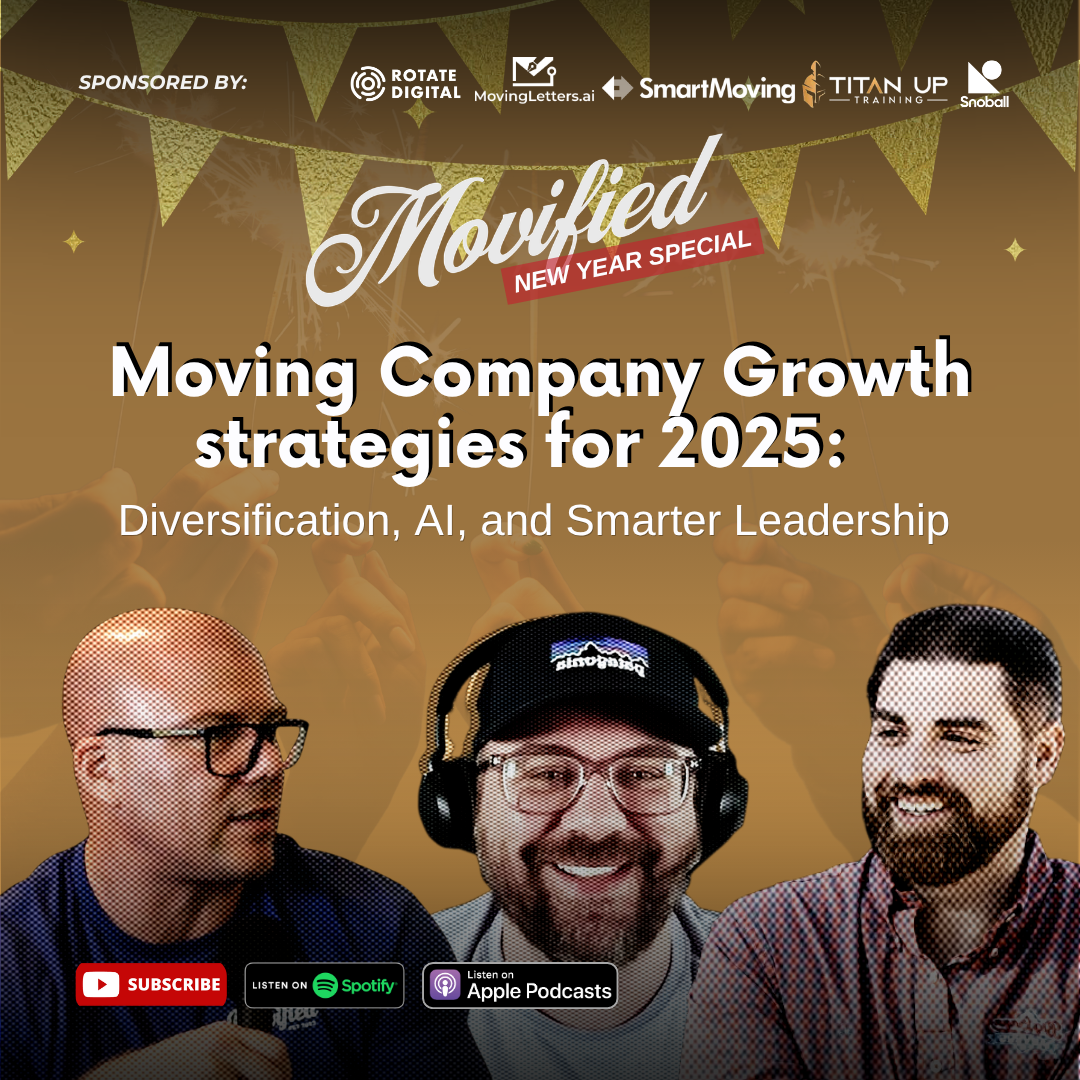
In this episode of Movified Wednesdays, host Mark Hirschi (owner of Salmon’s Moving & Storage, established 1913) sat down with Steven Reed of Big League Movers and ReadyRoles, alongside Brian Slater, to unpack their biggest wins, lessons learned, and future plans.
This blog post highlights their candid insights and provides a practical roadmap for owners, franchisees, and professionals who want to thrive in 2025.
Key Takeaways
What You’ll Learn:
- Diversify or risk collapse. No single marketing channel can carry your company safely year after year.
- Always test after change. Small tech errors (phone, CRM, QR codes) can silently drain revenue.
- AI + VAs are the new standard. Technology with human support is the most sustainable way to scale.
- Daily routines matter. Owners who build structure and balance achieve long-term clarity.
- Relationships fuel growth. Crews, clients, and community partners build a moat competitors can’t replicate.
Table of Contents
- The Reality of Moving Company Growth in 2024
- Diversification: Why It Matters More Than Ever
- How to Stop Silent Revenue Leaks
- AI, Virtual Assistants, and the Future of Ops
- Case Study: Scaling Through Passion, Not Just Profit
- Daily Habits That Keep Owners on Track
- Sustainability vs. Short-Term Profit
- How to Prepare for Q1 and Q2 2025
- Why Choose Movified
- Conclusion
The Reality of Moving Company Growth in 2024
For Steven Reed, 2024 revealed the razor-thin margin between scaling smart and scaling sloppy. His decision to expand marketing efforts with new hires and tools created gaps that were easy to overlook until it was too late.
A website revision left broken backlinks. A VoIP phone switch caused lost call transfers. And those issues hit hardest in May and June, peak months when moving companies typically secure 30–40% of annual revenue.
“When you drop in May and June, that’s where you lose your nut,” Steven explained.
The lesson? Growth isn’t about adding more. It’s about staying close to the levers that matter most.
Diversification: Why It Matters More Than Ever
Steven’s ability to diversify lead sources saved him from a complete disaster. Instead of relying only on digital ads, he built strength across multiple channels:
- Affiliate marketing partnerships with other businesses.
- Community involvement with local charities and sponsorships.
- Realtor and referral networks across Memphis.
- Truck branding and local exposure to maintain offline presence.
- Digital SEO + Paid Ads for scalable reach.
Brian emphasized that true local dominance requires being visible everywhere:
“If you’re crushing online but no Realtor in your city knows you, you can’t call yourself the king of your market.”
This balanced approach is why Steven earned his title as “The King of Memphis.”
How to Stop Silent Revenue Leaks
Too often, moving companies lose revenue because of small mistakes that snowball. A missing phone number, a dead QR code, or an unchecked landing page can bleed leads without anyone noticing.
Steps to protect your revenue flow:
- Call every tracking number after CRM/phone updates.
- Test all QR codes and links quarterly.
- Run mystery shopper tests on booking processes.
- Assign a VA to monitor lead channels weekly.
Brian summarized:
“If you see a 20–40% dip, don’t just blame the economy. Investigate the channel immediately.”
AI, Virtual Assistants, and the Future of Ops
Steven and Brian agreed that AI + VAs will separate winners from losers in 2025. Small business owners don’t have the bandwidth to track every software update, customer email, or marketing shift.
Practical AI & VA integrations for movers:
- Dialpad AI: Call scripts and automated summaries.
- ChatGPT or GPT-based tools: Draft claims replies or customer service templates.
- Twilio Segment: Personalized SMS/email campaigns at scale.
- Digital BOL + live truck tracking: Better customer transparency.
Steven’s ReadyRoles approach is unique because it avoids the trap of cheap short-term labor. Instead, his model trains VAs long-term in the moving industry.
Case Study: Scaling Through Passion, Not Just Profit
Brian shared how his company scaled from $1M to $25M+. What stood out was his reflection on where happiness peaked.
- At $1M, he loved knowing crews personally, engaging with customers, and celebrating wins.
- At $25M, he was buried in meetings, missing the connection that made the business fulfilling.
“Moving equips you with multi-dimensional skills—P&L, sales, recruiting, HR, marketing, operations. Most industries don’t give you that range.”
His advice for growth-minded owners: don’t chase short-term wins. Build for lifetime customer value and long-term crew relationships.
Daily Habits That Keep Owners on Track
Success isn’t just about systems—it’s about habits. The podcast guests shared their daily routines:
- Steven Reed: Early Peloton workouts, SOP writing, devotional reading, family breakfast, 15-min meeting buffers.
- Brian Slater: Custom “dashboard” command center, VA-managed calendar, knocks out micro-tasks instantly.
- Mark Hirschi: 4:30 a.m. wake-up, gym or reading, family breakfast, dispatch visits with donuts and coffee once or twice a week.
Each routine reflects a balance of discipline, leadership, and family grounding.
Sustainability vs. Short-Term Profit
One of the strongest themes was the importance of sustainable growth.
Steven explained:
“I can’t charge $10,000 for an $8,000 value. I want lifetime value, not one-off wins.”
This philosophy—building trust, fairness, and repeatability—is what separates respected brands from transactional operators.
Movers who focus only on squeezing customers or underpaying staff will struggle to survive in 2025. The winners will be those who think long-term.
How to Prepare for Q1 and Q2 2025
Looking ahead, here’s what the panel emphasized:
- Pay down debt early to reduce overhead stress.
- Expand HR capacity to support crew culture and client portals.
- Strengthen marketing funnels for seniors, restoration, storage, and packing jobs.
- Audit lead channels before peak season (April–May).
- Stay aggressive while others hesitate—own your market momentum.
Brian’s prediction:
“Everyone listening to this podcast can be 20% up in revenue in 2025, but only if they stay hungry and keep the same intensity as last year.”
Why Choose Movified
Movified isn’t just another podcast—it’s the leading content hub for movers. Hosted by Mark Hirschi, owner of Salmon’s Moving & Storage (over 110 years in business), the show gives listeners:
- Insider access to proven operators and franchise leaders.
- Candid stories about struggles and wins in the field.
- Practical playbooks you can apply immediately.
With guests like Steven Reed and Brian Slater, you get decades of moving experience distilled into actionable lessons.
Conclusion
The moving company growth strategies for 2025 boil down to three imperatives:
- Diversify. Don’t rely on one marketing channel.
- Test everything. Silent leaks can sink your busiest months.
- Adopt AI + VAs. They are the only sustainable way to scale.
Success will not come from shortcuts or silver bullets. As the Movified guests reminded us, it comes from discipline, passion, and staying hungry.
“Stay hungry, own the wave, and keep moving with purpose.”

Meet The Host
Mark Hirschi is the founder and host of Movified. With over a decade in the moving and storage industry, Mark combines real-world leadership experience with a passion for mentorship and elevating industry standards.