
Introduction
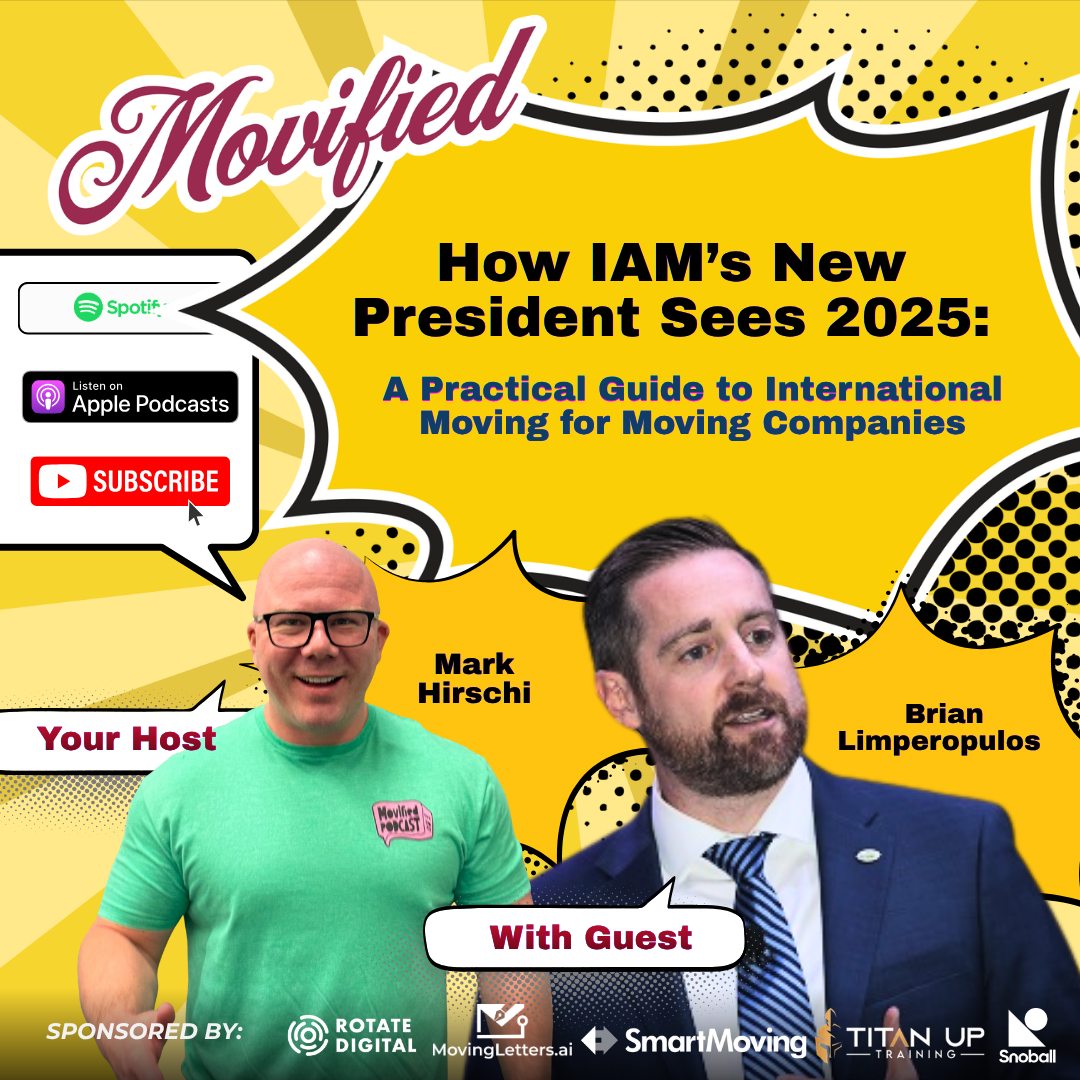
If you turn down international leads because they seem too complicated, you’re leaving money—and long-term partners—on the table. In this Movified interview recorded at the Canadian Association of Movers (CAM) Conference in Toronto, host Mark Hirschi speaks with Brian Limperopulos, the new president of the International Association of Movers (IAM). Together, they break down how international moving for moving companies can be a reliable revenue stream in 2025—even if you’re primarily a local operator today.
You’ll learn the simple model behind international work (origin → freight → destination), when to rely on a forwarder, how to avoid customs landmines, and what macro forces—tariffs, elections, and technology—mean for your sales pipeline next year. If you want a clear, step-by-step path to win global jobs without guesswork, this is your playbook.
Key Takeaways
What You’ll Learn:
- Don’t say no to international leads. Use a forwarder to manage door-to-door while you handle origin/destination services and keep the revenue.
- Join IAM to be seen and protected. Visibility to 2,200+ members and the Receivable Protection Program reduce risk and increase deal flow.
- Master three pillars: needs analysis, customs/regulations, and accurate pricing across origin–freight–destination.
- Data and tech matter. Better visibility (packing data, AI, container mapping) reduces exam risk and damage during customs inspections.
Table of Contents
- Why International Moving Belongs in Your 2025 Playbook
- The Three Pillars: Needs, Customs, Pricing
- Using Forwarders to Keep Revenue (Without the Headaches)
- Common Pitfalls and How to Avoid Them
- Tech, Data, and the Future of Container Visibility
- 2025 Outlook: Tariffs, Elections, and Demand
- Implementation Checklist for Owners and Sales Teams
- Case Snapshot: When a Container Goes Sideways
- Why Choose Movified
- Conclusion
Why International Moving Belongs in Your 2025 Playbook
Even if your bread-and-butter is local or intraprovincial work, international moving for moving companies is a logical extension of your current strengths. You already perform in-home or virtual surveys, prepare inventories, and execute high-quality pack/load services. Those same capabilities plug directly into international jobs as origin agent (OA) or destination agent (DA) functions.
Visibility and protection matter. According to Brian Limperopulos, IAM’s network spans 2,200+ companies worldwide. When you join, you become findable to global partners who need trusted OA/DA in your market. You also get access to IAM’s Receivable Protection Program (RPP)—a meaningful safety net if a partner fails to pay or goes out of business.
“If you’re already accepting business from IAM members, you might as well join and get protection over your services.” — Brian Limperopulos, IAM President
The Three Pillars: Needs, Customs, Pricing
1) Needs Analysis (Start Here)
Every successful international move begins with a thorough needs analysis. Ask:
- What are they moving (volume, high-value items, special handling)?
- Who is moving (family size, employer-sponsored vs. private)?
- Why are they moving (timeline, budget, flexibility)?
- Where from and to (route affects transport mode, security, and compliance)?
These points shape your packing plan, transit expectations, and cost ranges. They also help you set realistic timelines and communicate roadblocks early.
2) Customs & Regulations (Know What You Don’t Know)
International shipments cross borders; customs rules and government laws apply. Requirements vary by country and can even vary within ports. Household goods are a “mixed commodity,” which triggers more scrutiny than uniform shipments (e.g., a container of shoes). That reality makes documentation and partner selection essential.
Key actions:
- Provide clean, accurate inventories and packing lists.
- Flag restricted/prohibited items early (client education prevents delays).
- Use partners who understand the destination’s rules and processes.
- Document chain of custody clearly to speed up any customs exam.
3) Pricing Across Origin → Freight → Destination
Brian simplifies international moving into three parts:
- Origin: Survey, materials, pack, load, liftvans or container.
- Freight: Ocean or air carriage, terminal handling, security fees.
- Destination: Port clearance, delivery, unpack, debris removal, storage (if needed).
For international moving for moving companies, an easy win is quoting what you do best—OA/DA work—and partnering on the freight. As your team levels up, you can take on full door-to-door quoting with trusted forwarders.
Using Forwarders to Keep Revenue (Without the Headaches)
If a prospect calls about Winnipeg → New York, do not decline. Instead:
- Accept the lead and scope the job via needs analysis.
- Contact a forwarder in the IAM/CAM network to manage international routing.
- You handle OA/DA, keep that portion of the revenue, and let the forwarder price and oversee the freight leg.
- Communicate as one team, with defined hand-offs and timelines.
This approach lets you retain the customer while minimizing risk. Over time, as you build confidence and relationships, you can quote more of the door-to-door work directly.
Common Pitfalls and How to Avoid Them
Misrouted Containers
Yes, it happens. A container lands in the wrong country or wrong port. When that occurs, customs releases and re-routing become costly and stressful.
Prevention:
- Double-check routing instructions and port codes.
- Confirm documents match bookings.
- Maintain proactive status updates with the forwarder.
Customs Exams and Damage
Heavy inspection hubs (e.g., LA/Long Beach for U.S. exports) may intensively exam household goods. Unpacking and repacking by third parties can lead to damage.
Prevention:
- Pack with exam in mind (clear labeling, logical grouping, quality materials).
- Share packing lists that help target only required areas.
- Photograph container stow sections for reference.
- Prepare the client for possible delays and explain why exams happen.
Client Timeline Mismatch
Global moves with multiple hand-offs can stretch timelines, especially during peak seasons or geopolitical disruptions.
Prevention:
- Set expectations early with best-case and realistic windows.
- Offer groupage or LCL options for faster essentials.
- Provide updates on milestones (sailing, arrival, clearance, delivery).
Tech, Data, and the Future of Container Visibility
Customs authorities are more comfortable when they can validate what’s inside a container. Household goods look random on scanners, which triggers more inspections. Brian believes data transparency is the long-term fix.
Emerging opportunities:
- Container mapping: Digitally tag liftvans or zones to show where items sit.
- Enhanced inventories: Link items to a location matrix inside the container.
- AI packing capture: Scan, snap, and map as you load to create a visual index.
Result: Inspectors can target only the necessary items, reducing damage and speeding release. Forwarders and movers who adopt these practices will stand out to shippers and corporate accounts.
2025 Outlook: Tariffs, Elections, and Demand
Brian is cautiously optimistic about 2025. Here’s why:
- Election clarity typically restores corporate confidence, which can lift relocations.
- Tariffs could trigger inflationary pressure and dampen demand if enacted.
- Technology and consolidation will continue to reshape the supplier landscape.
- Consumer behavior is trending toward smaller, leaner shipments, not fewer moves.
What it means for international moving for moving companies: Get ready to process more partial shipments and essentials-only moves. Being fast, transparent, and data-driven will separate winners from the pack.
Implementation Checklist for Owners and Sales Teams
Use this to operationalize international moving this quarter:
Sales & Marketing
- Add “International Moving” to your website services with a clear OA/DA value.
- Publish a short FAQ on customs basics and timelines.
- Train sales to say yes and involve a forwarder within 24 hours.
- Create a lane cheat sheet (partners, ETAs, typical costs).
Operations
- Standardize international packing procedures and materials lists.
- Build a photo protocol (pre-load, load, post-load) with cloud storage.
- Adopt a labeling schema that aids targeted customs exams.
- Maintain a partner scorecard for forwarders and destination agents.
Finance & Risk
- Join IAM for the Receivable Protection Program and network visibility.
- Define payment milestones tied to shipment stages.
- Keep a contingency line for unexpected demurrage/inspection costs.
Training
- Run monthly lunch-and-learns on customs scenarios.
- Shadow your forwarder on two live files to learn routing/doc workflows.
- Document an escalation SOP for port holds, exams, and re-routing.
Case Snapshot: When a Container Goes Sideways
From the interview: one shipment arrived at the wrong international destination. Customs got involved, and without the customer present to receive the goods, the team had to retrieve and reroute the container—adding months to the timeline and significant costs.
Another real-world issue: after a meticulous pack job, a customs exam resulted in boxes being pulled apart and repacked haphazardly, causing damage.
Lessons learned:
- Build procedures for routing verification and document control.
- Prepare clients for the possibility of exams, especially on certain routes.
- Use photo documentation and a container map to minimize damage during exams.
- Keep clients informed with milestone updates to maintain trust.
Why Choose Movified
Movified is the moving industry’s insider channel—built by movers, for movers. Hosted by Mark Hirschi (owner of Salmon’s Moving & Storage and Ellis Moving & Storage), the show brings candid conversations with industry leaders like Brian Limperopulos. We translate executive-level insights into actionable SOPs your team can implement this week.
- 110+ years of moving heritage behind our perspective.
- Interviews with owners, franchisors, and vendors who’ve built scalable ops.
- Clear checklists, scripts, and templates paired with every episode.
Conclusion
International moving doesn’t have to be mysterious. With a strong needs analysis, a realistic understanding of customs, and a simple origin–freight–destination pricing approach, any quality local operator can add sustainable global revenue. Partner with forwarders, join IAM for visibility and protection, and invest in data practices that reduce exam risk.
Take action now:
- Listen to the full episode on the Movified Podcast.
- Implement the checklist above in your next sales mee Join IAM to get found and get protected (see iamovers.org).
“Don’t say no to the business. Use the network—through CAM or IAM—to connect with a forwarder. You can still do the OA or DA and keep that revenue.” — Brian Limperopulos

Meet The Host
Mark Hirschi is the founder and host of Movified. With over a decade in the moving and storage industry, Mark combines real-world leadership experience with a passion for mentorship and elevating industry standards.