
Introduction
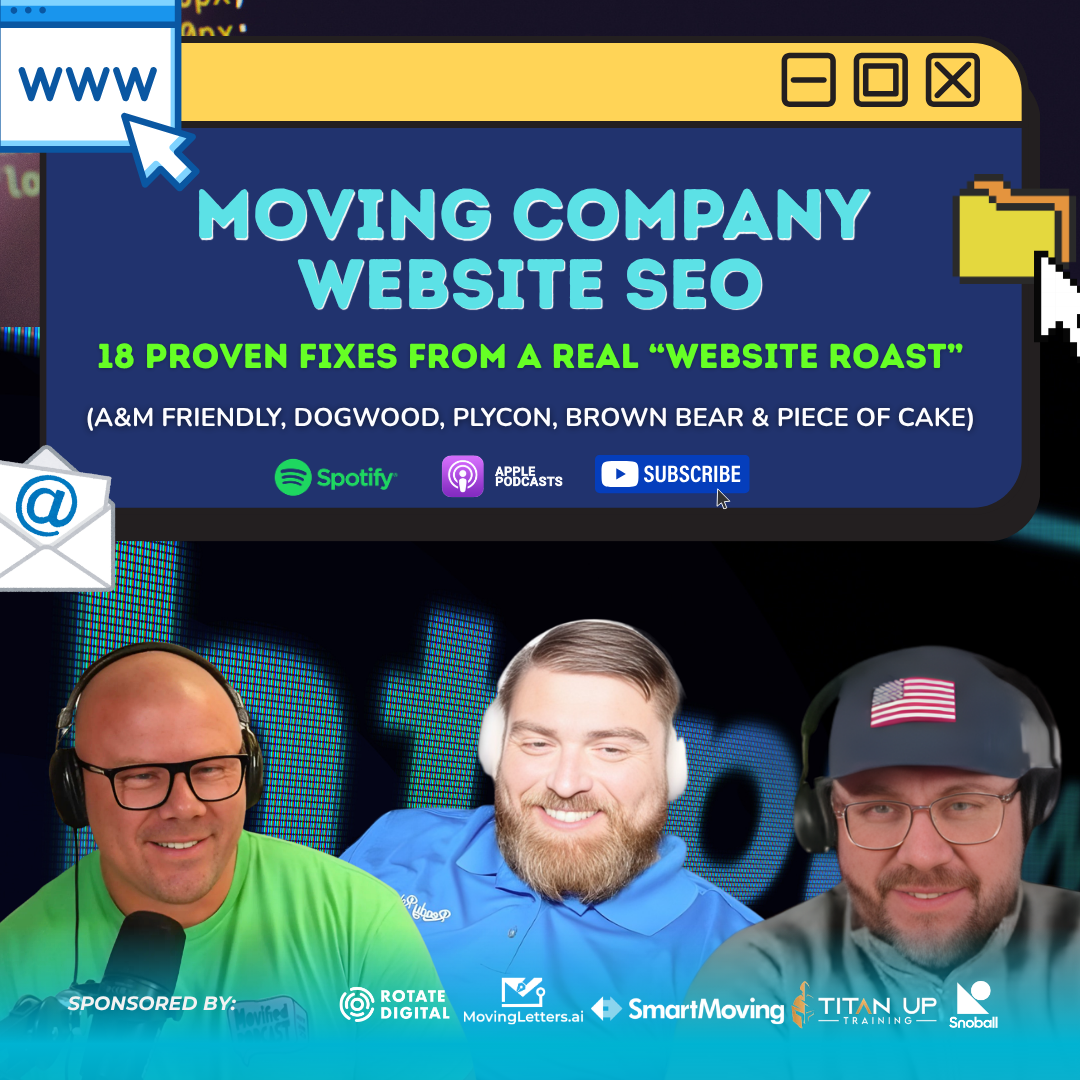
If your phones are quiet and your trucks sit idle, it might not be your sales team at fault—it’s your website. A weak website leaks leads, wastes ad spend, and stalls growth. That’s why Movified Wednesdays hosted a “Website Roast” with industry veterans Brian Slater and Stephen Reed alongside host Mark Hirschi.
In this session, they reviewed five real websites: A&M Friendly Movers, Dogwood Moving, Plycon/Plycar, Brown Bear Moving, and Piece of Cake. The goal wasn’t ridicule but to share practical, replicable moving company website SEO upgrades that any mover can implement.
Key Takeaways
What You’ll Learn:
- Above-the-fold is everything. Put your quote form, reviews, and CTA where customers see them immediately.
- Forms must be frictionless. Use one CRM-native form, connected via API, with address autocomplete.
- Trust signals need to be real. Show Google, Facebook, and Yelp review counts—not vanity badges.
- Automation is useful but limited. Allow self-service starts but keep a human in the sales loop.
Table of Contents
Section 1: Why Above-the-Fold Matters
The first screen a visitor sees is where 90% of their decision-making happens. If your hero banner doesn’t guide them toward a quote, you’ve lost them.
Checklist for your hero section:
- Headline: Make it specific and benefit-driven. (“Stress-Free Vancouver Moves Since 1913.”)
- Form: Keep it short (move date, origin/destination, home size, contact info).
- Primary CTA: “Get My Free Quote” works better than vague options like “Experience a Friendly Move.”
- Review proof: Add your Google star rating and review count right up top.
Section 2: Forms that Convert: The One-Form Rule
Every extra form means more friction and more lost leads. The roast showed how some companies had two different forms on one site—confusing for customers and hard to troubleshoot.
Best practices:
- Use your CRM’s native form (SmartMoving, Supermove) with a direct API connection. This ensures instant, reliable data flow.
- Add Google Places API to autocomplete addresses. Customers finish faster and errors drop.
- Keep to 5–7 fields. Skip outdated asks like “Phone type.” Assume mobile.
- Simplify “How did you hear about us?” with a two-step logic: channel → specific source.
Brian Slater shared a pro tip: use SendGrid or another SMTP provider to guarantee deliverability. High-volume movers sometimes lose web leads to spam folders without realizing it.
Section 3: Trust That Sells: Reviews vs. Badges
Customers don’t care about unknown “Top 3 Movers” awards you paid $80 for. They do care about thousands of 5-star Google reviews.
Dogwood Moving had:
- 1,873 Google reviews (5.0)
- 203 Facebook reviews (5.0)
- 56 Yelp reviews (4.8)
But those were buried low on the page, while vanity badges filled the hero. The panel’s advice: reverse that order.
Execution steps:
- Place review counters in the hero.
- Use a review carousel widget mid-page.
- Show one video testimonial above the fold.
- Push vanity awards to the footer or scrap them.
Section 4: Pricing and Expectation Control
Publishing your hourly rate may seem transparent. But it anchors customers to unrealistic totals.
Example: If you post “$229/hour,” customers assume a 2-hour move = $458. When it takes 6 hours, frustration rises.
Best practices:
- Provide ranges tied to home size and service type.
- Offer virtual or in-home surveys for accuracy.
- Use educational copy to explain variables (stairs, access, packing).
Section 5: Self-Booking vs. Human-Led Sales
Dogwood and Brown Bear experimented with self-booking forms that let customers choose crew size and hours. While slick, they create risk: customers under-scope moves.
Guidelines:
- Let customers start with a quote online.
- Always follow up with a human call or virtual survey.
- Add a clear note: “Every move is unique. We’ll confirm your details so your crew and truck are a perfect fit.”
Technology should speed intake, not replace professional consultation.
Section 6: Navigation and Copy Best Practices
Navigation:
- Logo on the left, linked to homepage.
- Menu should show Services, Locations, Storage, Reviews, Get a Quote.
- Avoid desktop hamburger-only menus.
- Remove header social icons (they bleed traffic).
Copy:
- Use simple, benefit-first headlines.
- Keep paragraphs under 150 words.
- Add subheadings every ~300 words.
- Replace vague CTAs with active ones: “Get My Free Quote.”
Branding:
- Retire stock photos. Use branded crew, trucks, and boxes.
- Lean into mascots/icons (Dogwood flower, Brown Bear paw).
- Keep wordplay (“Moving doesn’t have to be unbearable”) for subheads or CTAs.
Section 7: Mini Case Studies: 5 Websites Reviewed
A&M Friendly Movers
- Strength: Local family brand.
- Fix: Lead with form + reviews; shrink chat widget; unify forms; add Google autocomplete.
Dogwood Moving
- Strength: Custom brand identity.
- Fix: Move reviews up; fix broken video buttons; streamline nav; reduce social icons.
Plycon / Plycar
- Strength: Multi-service, international scale.
- Fix: Add above-the-fold quote form; vectorize logo; fix buggy forms; simplify service categories.
Brown Bear Moving
- Strength: Memorable paw branding and witty copy.
- Fix: Improve logo legibility; swap stock for brand photos; add a flagship mascot; simplify nav.
Piece of Cake
- Strength: Model site—reviews + CTA above fold, brand saturation, heavy SEO.
- Lesson: Brand presence across web, city, and trucks reinforces conversion.
Section 8: 7-Day Implementation Plan
Day 1: Redesign hero with form + reviews.
Day 2: Install CRM-native API form + Google Places.
Day 3: Add review widgets; move badges down.
Day 4: Simplify navigation; logo left; About Us link.
Day 5: Add “Book a Video Survey” CTA.
Day 6: Replace stock with branded photos.
Day 7: Test everything—submit fake leads, confirm deliverability.
Why Choose Movified
Movified is built by movers, for movers. Host Mark Hirschi has scaled Salmon’s Moving & Storage for decades and now shares insider strategies through the Movified Podcast. Guests like Brian Slater, Stephen Reed, and other operators bring battle-tested lessons to the table.
When it comes to moving company website SEO, you won’t just hear theory—you’ll see what actually works in live businesses.
Conclusion
A better website doesn’t require reinventing the wheel. It requires clarity, proof, and simplicity. Lead with your form and reviews, clean up your nav, and let your brand shine. These 18 fixes from our live roast will increase leads without increasing ad spend.
“Every customer will hit your website. Keep your digital front lawn trimmed.” — Movified Panel

Meet The Host
Mark Hirschi is the founder and host of Movified. With over a decade in the moving and storage industry, Mark combines real-world leadership experience with a passion for mentorship and elevating industry standards.