
Introduction
Every moving company owner reaches a crossroads: keep grinding year after year, or build something with enough value to sell, scale, or step away from. The challenge? Most owners don’t plan far enough in advance to maximize their company’s worth. They focus on the day-to-day grind—trucks, crews, invoices—without creating a structure buyers or investors will pay top dollar for.
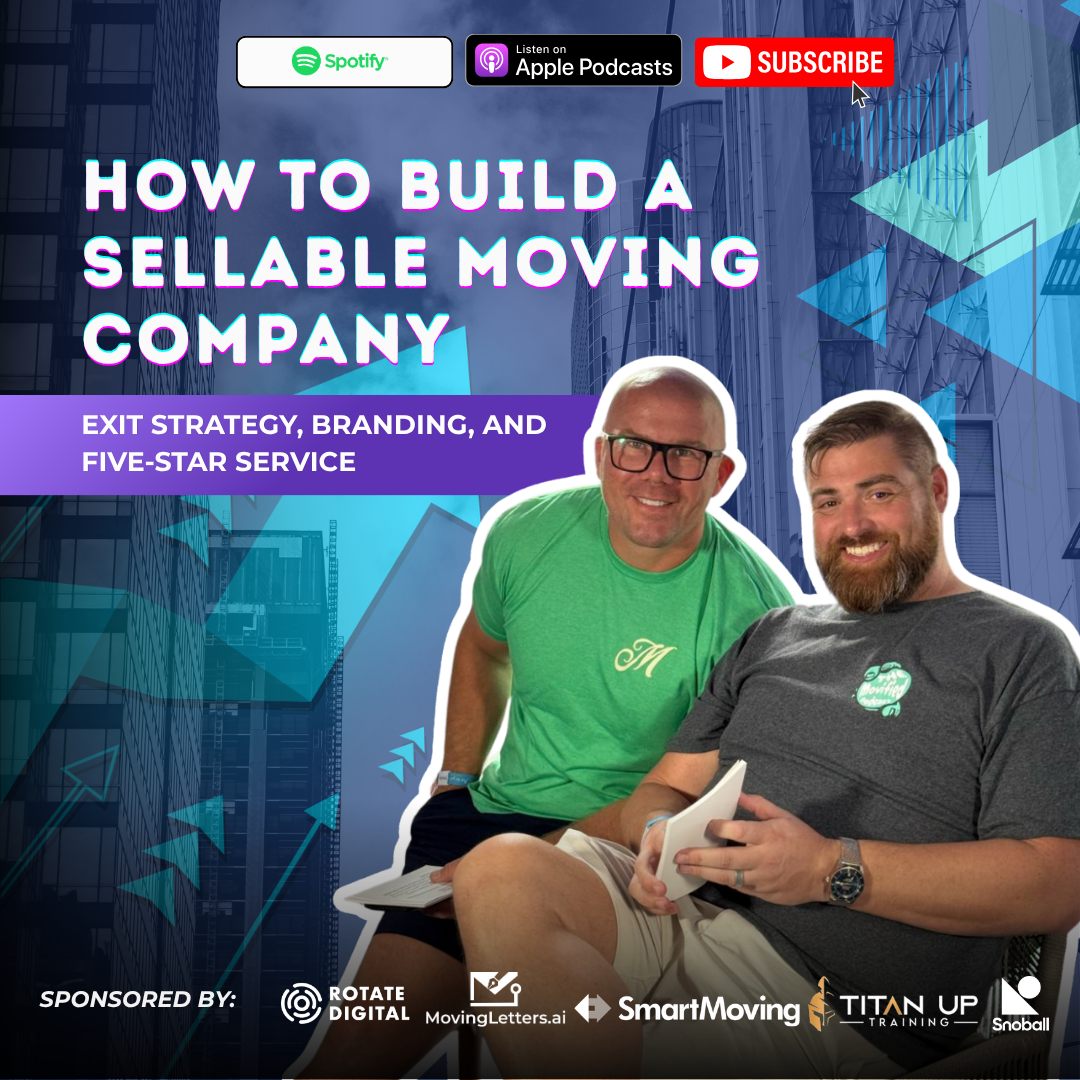
In this Movified Wednesday Podcast, host Mark Hirschi (owner of Salmon’s Moving & Storage in Vancouver, BC) and industry leader Steven Reed unpack what it takes to build a sellable moving company. From planning five years ahead to building systems and teams that thrive without you, their conversation is full of lessons that every moving professional can apply today.
This blog post translates that conversation into practical strategies for moving company owners, franchisees, and industry professionals who want to:
- Prepare for a profitable exit,
- Build long-term resilience, and
- Deliver customer service that generates five-star reviews every time.
Key Takeaways
What You’ll Learn:
- Plan your exit strategy at least five years ahead to capture maximum company value.
- One buyer is no buyer—competition drives better exit outcomes.
- A truly sellable moving company runs on people and systems, not just trucks.
- Strong branding, uniforms, and wrapped trucks act as moving billboards that attract customers.
- Building a five-star service culture creates repeat business and protects your reputation.
Table of Contents
- Exit Planning Defines Business Value
- Why One Buyer Is No Buyer
- Building Systems and Teams That Attract Buyers
- Early Struggles That Teach Long-Term Lessons
- Branding, Uniforms, and Trucks: Your Rolling Billboard
- Creating a Five-Star Customer Service Culture
- Learning From Industry Peers and Mentorship
- Events, Networking, and Why Timing Matters
- Why Movified Is the Insider Resource for Movers
- Conclusion
Exit Planning Defines Business Value
A sellable moving company doesn’t just appear one day—it’s deliberately built. Steven Reed stressed that planning at least five years ahead makes the difference between an undervalued exit and a highly profitable one.
Too many owners think, “I’ll push through a few more years and then sell.” Without foresight, your business looks messy, underdeveloped, and harder to transfer. Buyers will discount accordingly.
By mapping out a five-year plan that includes financial targets, growth strategies, and leadership development, you create a company that’s not just profitable today but attractive tomorrow.
“If you plan five years ahead—where you’re going, where the market’s going, how you validate that—you create a business with real value today.” – Steven Reed
Why One Buyer Is No Buyer
Steven’s most powerful insight: “One buyer is no buyer.”
If you only have one interested buyer, you’re at their mercy. They can push down the price, stretch negotiations, and strip away value because you have no fallback option.
The key is to position your company so multiple buyers are interested. This creates competitive tension, driving up your price and terms.
One example Steven shared: an owner who always dreamed of franchising. Instead of pitching her business as “ready for sale,” she went to market saying, “I’ve built this company; I don’t want day-to-day operations, but I know how to grow it across multiple cities.” Buyers competed to back her expansion rather than simply buy her out.
The lesson? Pitch not only what your company is today, but what it could become in the hands of the right buyer.
Building Systems and Teams That Attract Buyers
Revenue and trucks may seem like the most obvious signs of value, but buyers are looking deeper. What they truly want is a business that runs without the owner.
That means:
- Documented systems for dispatch, payroll, and customer communication.
- Key employees empowered to run departments independently.
- A clear plan for sustainable growth that doesn’t depend on the founder.
Mark emphasized:
- Your people and processes are your assets.
- A buyer pays more when leadership and systems are in place.
- Without those, you’re selling a stressful job, not a business.
This is why hiring strategically, creating Standard Operating Procedures (SOPs), and using tools like CRMs and financial dashboards are non-negotiable for any owner who dreams of selling.
Early Struggles That Teach Long-Term Lessons
Every owner makes mistakes in the early years, and both Mark and Steven shared painful ones that later shaped their approach:
- Partnerships gone wrong: Conflicting visions slowed growth.
- Messy financials: Phantom bonuses lowered tax bills but prevented access to bank credit for expansion.
- Cash chaos: Paying employees out of jeans stuffed with bills blurred personal and business lines.
The reality is that early shortcuts come back to haunt you. A truly sellable moving company has:
- Proper financial statements,
- A bankable credit history,
- And clean, trackable payroll and tax systems.
Branding, Uniforms, and Trucks: Your Rolling Billboard
You can’t build a sellable moving company without a brand that customers recognize and trust. Mark and Steven laughed about movers who ask if they should buy a billboard while driving around with blank, unbranded trucks.
Your trucks are rolling billboards, and investing in proper wraps and logos pays dividends daily. Pair that with uniformed crews and you’re immediately more credible than the guy in tank tops and plain T-shirts.
Examples from the podcast:
- Chris Knowles of True Friends Moving: Known for consistent use of blue across trucks, uniforms, and marketing.
- Austin Yarborough of Central Coast Moving: Recognizable everywhere in his branded golf shirts.
Consistency builds credibility, which in turn builds value. Buyers know that a strong brand translates to future revenue.
Creating a Five-Star Customer Service Culture
Customer reviews can make or break a moving company. To build a sellable moving company, you need a system that consistently produces five-star feedback.
Steven shared a Disney-inspired model: every employee finishes interactions with,
“If you receive anything less than five-star service today, please let us know.”
This constant reinforcement primes customers to think in five-star terms and empowers them to flag issues immediately—so they’re solved before becoming negative reviews.
At Big League Moving, Steven’s team builds this into every step:
- Booking calls
- Confirmation calls
- Pre-move packing checks
- Day-of text updates
- Mid-move check-ins
By prompting feedback at every touchpoint, the company controls its reputation proactively.
Learning From Industry Peers and Mentorship
Another highlight from the podcast: the importance of mentorship and peer groups.
Mark reflected on how earlier in his career he resented employees who left to start their own moving companies. Today, his mindset has shifted: he now encourages employees to thrive, even if that means one day leaving.
Growth-minded leaders surround themselves with like-minded owners, share knowledge, and keep each other accountable. The “Let’s Go Boys” group—formed with movers like Neacail Murdock at Murdock’s Moving and Storage, Austin at Central Coast Moving & Storage, Josh at Coastal Carrier, and Matt at iHaul iMove—proves how collaboration fuels growth.
Events, Networking, and Why Timing Matters
Mark also explained why timing matters in building culture and community. For example, Salmon’s Moving & Storage holds its winter party in January rather than December, so it doesn’t compete with other holiday events.
December is a prime networking month for movers—full of community toy drives, partner parties, and client events. A smart owner leverages that calendar for visibility and relationships, then celebrates internally in January.
These decisions may seem small, but they demonstrate the long-term thinking of a sellable moving company.
Why Movified Is the Insider Resource for Movers
Movified isn’t just another podcast—it’s the leading content hub for moving company owners.
- Hosted by Mark Hirschi, owner of Salmon’s Moving & Storage, one of Canada’s oldest moving companies (since 1913).
- Featuring real owners like Steven Reed, sharing battle-tested strategies.
- Covering everything from acquisitions and branding to recruiting and customer service.
If you’re serious about building a sellable moving company, Movified is your competitive edge.
Conclusion
Building a sellable moving company requires vision and discipline. Plan your exit five years ahead, attract multiple buyers, document systems, build a strong brand, and create a five-star service culture. These aren’t just nice-to-haves—they’re the building blocks of value.
As Steven Reed and Mark Hirschi reminded us, your company is only as valuable as the systems, people, and reputation behind it. Don’t just run a business—build an asset.

Meet The Host
Mark Hirschi is the founder and host of Movified. With over a decade in the moving and storage industry, Mark combines real-world leadership experience with a passion for mentorship and elevating industry standards.